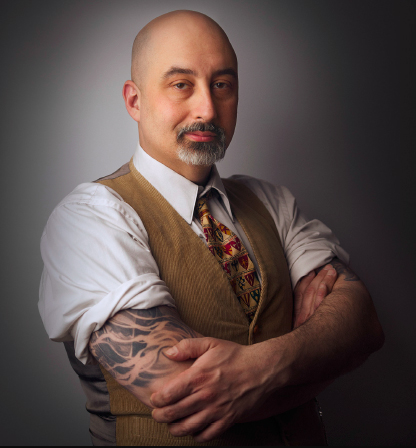
 Ken recieved his PhD from Fordham University in 2010 and has taught at (inter alia) the University of Massachusetts, Boston University, and Westfield State University. He also led fencing classes at the Higgins Armory Museum from 2009–2013 and teaches non-fiction writing at the Pioneer Valley Writer's Workshop. His academic expertise includes Western Civilization from the ancient world to the present and the history of imperalism and global interconnections, with specialties in the history of science; the study of jousting, tournaments, horsemanship, armor, and historical European martial arts (HEMA—a subject that is truly multum in parvo for those interested in violence, court culture, and intellectual and scientific history); medieval and Renaissance social, cultural, and intellectual history; and pop-culture depictions of the medieval and medievalesque such as Lord of the Rings and Game of Thrones.
The central motif of Ken's academic work may be summed up as "the representation of time in the Western tradition"—not just fencing (which takes place in time and space), but also clocks and scientific measurement of time. However, Ken has also written and taught extensively on medieval ideas of race, gender, and expansion and has a strong interest in countering white-nationalist uses of the Middle Ages.
College classes he has taught include:
• Introductory classes in Modern and Pre-Modern European and World History
• Ancient History
• Medieval History
• The Renaissance and Reformation
• Medieval and Early Modern European Expansion and Colonization
• Medieval and Early Modern Warfare
• The History of Fencing and Dueling
• The History of Science
• Animals in History and Literature
• Modern World History
He also teaches privately as a fencing instructor.
If you are an undergraduate or graduate student interested in having Dr. Mondschein as a thesis reader, or an advisor for a course of independent study, please have your academic advisor contact him directly (ken -at- kenmondschein dot com).
Ken's teaching philosophy, whether in the classroom or on the fencing piste, is geared towards the individual student. Each person is unique, bringing unique gifts, experiences, and insights with them, and learning in a different way. Teaching must, in turn, be tuned to each person's pitch. The best education is not accomplished through mechanical repetition of facts or by rote drill, but by awakening the student to the power of his or her own intelligence to see patterns in the world.
This approach is eminently well-suited to the teaching of history, for history is all around us. Behind the most seemingly mundane and everyday things lie centuries and even millennia of development. These stories, played out in the arenas of the arts, politics, and religion, tend to fascinate people. By uncovering the causes behind the effects, we not only gain a superior understanding of our world, but, by uncovering the universal principles that govern all of our lives, also empower ourselves to change it.